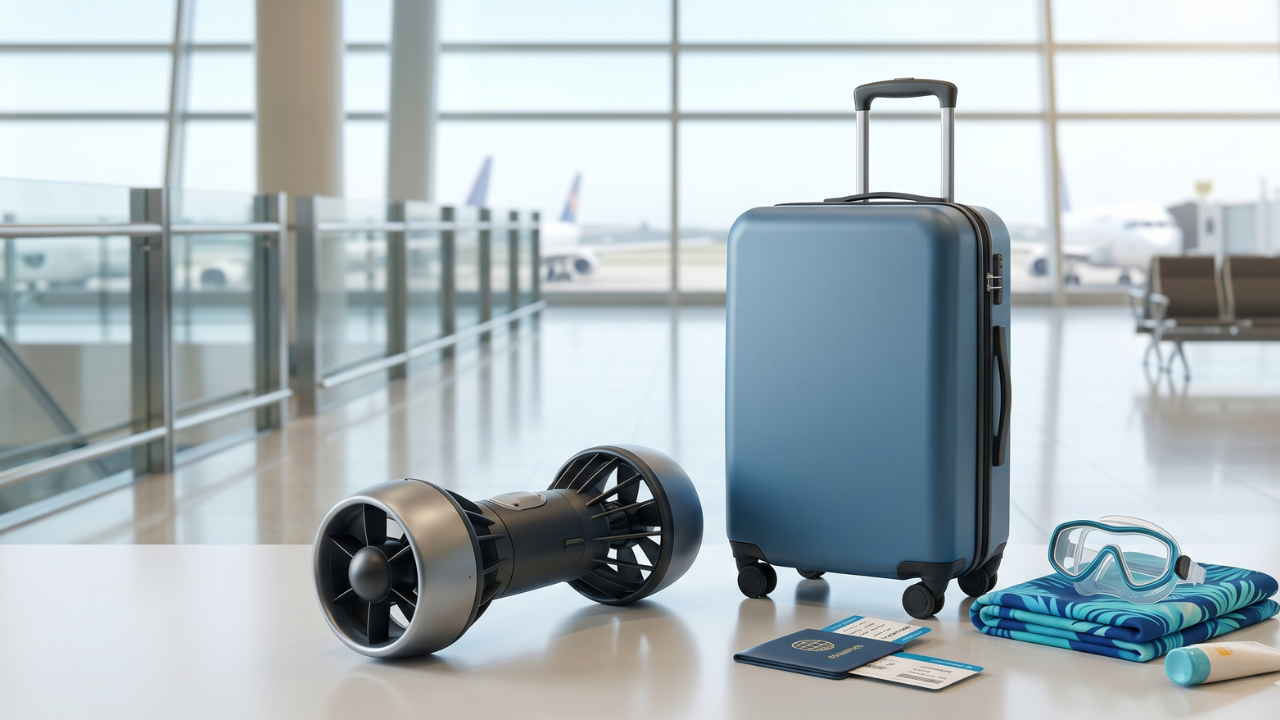
Underwater scooters, also called sea scooters or diver propulsion devices, have become popular with snorkelers, swimmers, and vacation travelers who want to explore the water with less effort. They are compact, fun, and powerful enough to turn a beach trip into a more exciting adventure. But when your next vacation involves a flight, one question matters more than anything else: can you travel with an underwater scooter on a plane?
The short answer is yes, in many cases you can travel with an underwater scooter on a plane, but the battery rules are the deciding factor. Most underwater scooters use rechargeable lithium-ion batteries, and airlines treat lithium batteries carefully because damaged or overheated batteries can create a fire risk. That means the scooter body, the battery size, how the battery is packed, and the airline policy all matter before you arrive at the airport.
This guide explains the main things travelers should know before flying with an underwater scooter, including battery watt-hour limits, carry-on versus checked luggage, packing tips, and what to confirm with your airline before your trip. For more travel and technology guides, you can also browse Almawadahit.com.
Quick Answer: It Depends on the Battery
An underwater scooter is usually allowed for air travel only if its lithium battery fits within the airline and aviation authority limits. In general, smaller lithium-ion batteries up to 100 watt-hours are easier to travel with. Batteries between 101 and 160 watt-hours may require airline approval. Batteries above 160 watt-hours are often much harder to bring on passenger aircraft and may not be accepted for normal passenger travel.
Because different airlines and countries can apply stricter policies, you should never assume your scooter will be accepted simply because it fits inside a suitcase. Check the battery label, confirm the watt-hour rating, read the airline dangerous goods policy, and contact the airline before your departure date.
Why Airline Rules Focus on the Battery
The scooter itself is usually not the biggest issue. The main concern is the lithium-ion battery that powers the motor. Lithium batteries are common in laptops, cameras, power banks, drones, and many portable devices, but they must be handled correctly during air travel. Airlines want to know whether the battery is installed, removable, protected from short circuit, damaged, or too large for passenger baggage rules.
For underwater scooters, this is especially important because some models are designed for casual snorkeling while others are built for deeper or longer underwater use. Larger models may include higher-capacity batteries, which can exceed standard passenger limits. Before booking your flight, find the watt-hour rating on the battery or in the product manual.
How to Check the Watt-Hour Rating
Most travel decisions come down to watt-hours, often shown as Wh. Many batteries display this rating directly on the label. If the battery only lists voltage and amp-hours, you can estimate watt-hours by multiplying volts by amp-hours. For example, a 25.2V battery rated at 5Ah equals about 126Wh.
This number matters because a 126Wh battery may fall into the 101 to 160Wh range, which often requires airline approval, while a 252Wh battery is above the common passenger limit for many consumer electronic devices. If the watt-hour rating is missing, unclear, or not printed on the battery, airline staff may refuse it even if the scooter is otherwise safe.
Carry-On or Checked Luggage?
A practical approach is to separate the scooter body from the battery if your model allows it. The scooter body, without the battery, can often be packed in checked baggage as long as it is clean, dry, protected from damage, and within airline size and weight limits. The lithium battery, however, is normally better carried in the cabin because cabin crew can respond faster if a battery overheats.
Spare lithium batteries should be kept in carry-on baggage only and protected from short circuit. That means covering exposed terminals, using the original battery case if available, or placing the battery in a protective pouch. Never pack a loose battery where metal objects such as keys, coins, or tools can touch the terminals.
When You Need Airline Approval
If your underwater scooter battery is over 100Wh but not over 160Wh, you should contact the airline before your flight. Ask whether they allow the battery, whether it must be removed from the scooter, whether it must travel in carry-on baggage, and whether they need documentation from the manufacturer.
Keep your approval email or written confirmation with you. Airport agents may ask for proof, especially if the battery label is difficult to read. It is also smart to keep the product manual or battery specification page saved on your phone and printed in your carry-on bag.
What About ASIWO Manta and Similar Underwater Scooters?
Many travelers search for compact models because they are easier to carry and more realistic for vacations. If you are comparing Underwater scooters, always compare battery size as carefully as speed, depth rating, and runtime. A portable scooter may still require airline approval if the battery is above 100Wh.
For example, shoppers often look at options like the ASIWO Manta underwater scooter because compact sea scooters are designed for pool, snorkeling, and recreational water use. The key travel question is not only whether the scooter is small enough for a bag, but whether the specific battery in your model fits the airline limits.
Packing Checklist Before You Fly
Before packing an underwater scooter for a flight, use this simple checklist:
- Check the battery watt-hour rating on the battery label.
- Confirm whether the battery is removable.
- Contact the airline if the battery is between 101Wh and 160Wh.
- Do not travel with damaged, swollen, recalled, or leaking batteries.
- Protect battery terminals from short circuit.
- Carry spare batteries in cabin baggage only.
- Pack the scooter body securely so the power button cannot be activated accidentally.
- Bring the manual, battery label photo, and airline approval email.
- Arrive at the airport early in case staff need to inspect the item.
Common Mistakes That Can Cause Problems at the Airport
One common mistake is assuming that a sea scooter is treated like normal sports equipment. In reality, the lithium battery places it under battery safety rules. Another mistake is packing the battery deep inside checked luggage, where it may be removed during screening or rejected by the airline.
Travelers also run into problems when the battery label is missing or when they cannot explain the watt-hour rating. If an airport agent cannot verify the battery capacity, they may choose the safest option and refuse the battery. A few minutes of preparation can prevent delays, confiscation, or having to leave your scooter behind.
For more practical guides and updates, check the Blog category on Almawadahit.com.
Safety Tips for Traveling with an Underwater Scooter
Make sure the scooter is completely dry before you pack it. Saltwater, moisture, and sand can damage parts and create issues during inspection. Clean the device after your last swim, let it dry fully, and pack it in a padded section of your luggage.
If the scooter has a removable propeller guard or accessories, secure them separately so they do not break in transit. Avoid overpacking around the scooter because pressure can damage controls, seals, or the battery compartment. If the model has a travel lock or safety mode, enable it before packing.
Check Rules at Your Destination Too
Airline rules are only one part of the travel plan. Some resorts, beaches, marine parks, pools, or protected water areas may restrict powered water devices. Even if your airline accepts the scooter, your destination may have local rules about where you can use it.
Responsible use is important. Avoid coral reefs, swimmers, wildlife, and crowded areas. Follow local safety instructions, use the scooter only within its rated depth, and supervise children carefully. An underwater scooter should make travel more enjoyable without creating risk for other people or the environment.
Should You Fly with One or Rent at Your Destination?
If your scooter has an airline-friendly battery and you travel often, taking your own device can be convenient. You already know how it works, how long the battery lasts, and how to maintain it. However, if your scooter battery is above the airline limit or your route involves multiple carriers, renting at the destination may be easier.
Renting can also reduce luggage weight and remove the stress of battery approval. The downside is that rental models may not be available everywhere, and you may not know the condition or battery health of the rental equipment. Choose the option that fits your trip, airline, budget, and comfort level.
Final Answer: Yes, But Prepare Before You Fly
You can often travel with an underwater scooter on a plane, but the battery decides how simple or complicated the process will be. A small battery may be easy to bring, a 101 to 160Wh battery may need airline approval, and a larger battery may not be accepted under normal passenger baggage rules.
The safest plan is to check the watt-hour rating, contact the airline, keep the battery protected in carry-on baggage when required, and bring documentation. With the right preparation, your underwater scooter can be part of a smooth beach, snorkeling, or diving vacation instead of a stressful airport problem.
If you need to ask about publishing or corrections for this article, use the contact page on Almawadahit.com.